Signs It's Time for Assisted Living: A Guide for Ossining Families
A calm guide to changes at home, caregiver strain, family conversations, respite stays, and care costs for Ossining families.
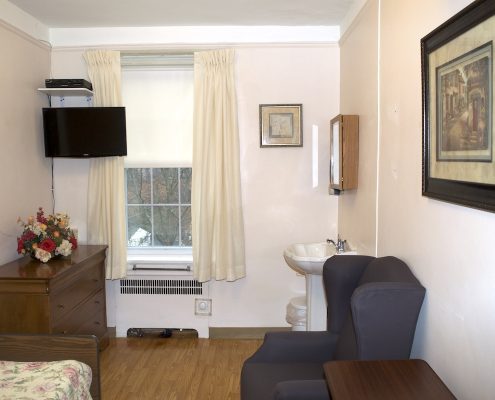
For Ossining families, the signs it's time for assisted living usually appear as a pattern rather than a single event. A parent may say everything is fine while meals become irregular, laundry accumulates, or a spouse loses sleep to provide supervision. The goal is not to catalogue failures or force a quick decision. It is to notice changes, understand what support could look like, and make choices before a crisis narrows them.
Victoria Home is an assisted living adult care residence at 25 N Malcolm St in Ossining, in a historic Hudson-side building overlooking the Hudson River. Its Westchester County location may be convenient for families in Croton-on-Hudson, Briarcliff Manor, and Tarrytown, including those using the Metro-North Hudson Line. This guide offers ways to observe and plan; it cannot determine whether a particular person should move.
Signs it's time for assisted living in Ossining
A single missed bill or untidy room does not settle the question. Look for changes that repeat, cluster together, or require increasing family effort. Notes kept over several visits can be more useful than impressions formed during a holiday or immediately after an illness. Focus on what your parent is actually doing, not on what either of you expected at this age.
- Personal routines: Bathing, dressing, or toileting becomes inconsistent, or your parent regularly needs prompting or hands-on help.
- Meals and household tasks: The refrigerator holds little fresh food, meals are skipped, or cleaning and laundry routinely exceed your parent's capacity.
- Medication routines: Pills remain untaken, doses appear duplicated, or the routine depends on repeated family reminders.
- Mobility and home safety: A fall, new difficulty with stairs, or unsafe stove use raises concern about being alone.
- Judgment and daily business: Unopened mail, unpaid bills, or unusual purchases suggest that everyday business is becoming harder to manage.
These observations do not diagnose a condition. They identify practical issues to discuss with your parent and, when appropriate, a qualified professional. The central question is whether daily life remains manageable without relying on constant improvisation.
Look at safety, connection, and caregiver strain together
Safety includes more than fall risk. Consider whether your parent can respond to a smoke alarm, obtain help after an accident, manage food safely, and get through the night without supervision. Frequent family check-ins can fill gaps for a while, but they may also conceal how much support is required. Write down who is helping, which tasks they cover, and what happens when someone is unavailable.
Social withdrawal deserves equal attention. A parent may stop attending familiar activities because transportation, hearing, mobility, or confidence has changed. Loneliness is not, by itself, proof that a move is necessary; it is a reason to ask what has become difficult. Caregiver strain matters too. A spouse who is exhausted, injured, or missing appointments may be providing more care than is sustainable. Adult children can experience the same strain when work, parenting, and long drives to Ossining compete with daily caregiving.
Start the conversation without taking over
If the signs it's time for assisted living in Ossining have become a repeated pattern, begin with curiosity rather than a verdict. Your parent should have opportunities to describe concerns, preferences, and fears before relatives propose solutions.
- Choose an unhurried moment. Avoid starting immediately after a fall, argument, or stressful appointment.
- Use specific observations. Describe missed meals, medication confusion, or the number of tasks family members are covering instead of labeling your parent as incapable.
- Ask about priorities. Privacy, familiar surroundings, help with particular tasks, and relief for a spouse may carry different weight.
- Offer manageable choices. A needs assessment, a visit to a residence, or a discussion with the person currently providing care can each be a separate step.
- Agree on a follow-up. End with what will happen next and when everyone will talk again.
Reading about assisted living in Ossining before the conversation can make the options more concrete. Do not present a tour as a commitment or use siblings to pressure a reluctant parent. Unless urgent safety concerns require faster action, patience usually preserves more trust than a surprise decision.
Use respite care as a practical trial
A short period of support can answer questions that a brochure cannot. The National Institute on Aging explains respite care as a temporary break for family caregivers, provided at home, through adult day centers, or during short residential stays. It can show which routines feel comfortable, which tasks still require help, and how a spouse responds to having dependable time off.
A respite stay is not a test your parent can fail, and it does not guarantee that a permanent move will feel the same. If considering Victoria Home, ask directly whether respite stays are available, along with their length, admissions requirements, included services, and current rates. Bring familiar belongings and a clear list of routines. Afterward, invite your parent to describe both positive and difficult parts of the experience before relatives draw conclusions.
What local cost figures mean for planning
National averages cannot supply a local budget. The CareScout Cost of Care Survey 2025, based on data collected July through November 2025, places Ossining in its New York Area. That is the metro region CareScout uses for Westchester County, not an Ossining-only median and not a quote from Victoria Home.
| Setting and area | Monthly | Annual |
|---|---|---|
| Assisted living, New York Area | $9,450 | $113,400 |
| Assisted living, New York statewide | $7,110 | $85,320 |
| Assisted living, U.S. national | $6,200 | $74,400 |
| Nursing home semi-private room, New York Area | $14,448 | $173,375 |
| Nursing home private room, New York Area | $15,969 | $191,625 |
For assisted living, the New York Area monthly median is $2,340 higher than the statewide monthly median and $3,250 higher than the national monthly median. A median is a planning benchmark, not a statement about what any community charges or includes. Families should call Victoria Home for current rates and request a written explanation of included services, additional charges, and rate-change policies.
The same CareScout survey lists non-medical in-home care at $37 an hour in the New York Area. Its monthly estimate at 44 hours per week is $7,055, which is $2,395 less than the metro assisted living median. At 20 hours per week, the hourly-rate calculation is $3,207 a month; around-the-clock care at 168 hours per week is $26,936. Adult day health care is listed at $144 a day and $3,120 a month.
These options are not interchangeable. Home care can leave household, meal, and coordination responsibilities with the family, while community contracts vary. The monthly nursing home figures above are $4,998 higher for a semi-private room and $6,519 higher for a private room than metro assisted living. Nursing homes and assisted living serve different needs, so price alone should never determine placement.
Check payment rules and New York licensing
Medicare's long-term care guidance says Medicare does not cover long-term custodial care when that is the only care needed, and notes that most long-term care is custodial. Do not assume a short-term medical benefit will pay an ongoing assisted living bill.
Long-term care insurance may pay for assisted living, depending on the policy. Benefits generally begin after an elimination period and when policy conditions involving daily activities or cognitive impairment are met. Read the policy and ask the insurer about benefit triggers, covered settings, limits, and required documentation.
The VA Aid and Attendance benefit can add an amount to a VA pension for eligible wartime-era Veterans or surviving spouses who need help with daily activities or meet other criteria. It is not automatic. Pension calculations, countable income, assets, and documented expenses require individual review.
New York's adult care facility guidance explains the state's licensing categories, including Assisted Living Residences and Enhanced or Special Needs certifications. The state consumer guide says Medicaid generally does not pay to live in an Assisted Living Residence. A separate Medicaid Assisted Living Program operates in some adult homes and enriched housing programs for eligible participants, with prior authorization and periodic reassessment. Participation should never be assumed.
Make the next step specific and reversible
Create a shared list of observed needs, your parent's priorities, caregiver limits, and financial questions. Bring the same list to every provider. Ask who assesses needs, how medication support and overnight concerns are handled, what happens when needs change, and which services would cost extra. Distinguish what is available now from what might require another move.
For Victoria Home, families can schedule a tour and confirm its current license and admissions criteria directly. Victoria Home is not a dedicated memory care community, so families seeking dementia-specific support should ask plainly whether the available environment and supervision fit their situation. A careful decision can respect both a parent's wish for familiarity and the family's need for safe, sustainable daily support.
Frequently asked questions
What changes should Ossining families watch for before considering assisted living?
Look for repeated patterns rather than one bad day: difficulty with bathing or dressing, spoiled food or an unmanageable home, missed or duplicated medication doses, unsafe stove use, mobility problems, unpaid bills, withdrawal from familiar activities, or a spouse becoming exhausted. These observations do not diagnose a condition. They show where an assessment and a conversation about daily support may be useful. Immediate danger calls for prompt professional help.
How much does assisted living cost near Ossining?
CareScout's 2025 survey places Ossining in its New York Area, where the assisted living monthly median is $9,450 and the annual figure is $113,400. New York's statewide monthly median is $7,110. These are planning benchmarks, not Victoria Home's rates or an Ossining-only survey. Families should call Victoria Home for current rates and ask which services, fees, and possible care-related charges are included.
Does Medicare pay for assisted living in Ossining?
Medicare does not cover long-term custodial care when that is the only care needed, so families should not count on it for an ongoing assisted living bill. New York's consumer guidance also says Medicaid generally does not pay to live in an Assisted Living Residence. A separate Medicaid Assisted Living Program exists in some adult homes and enriched housing programs, with eligibility, prior authorization, and reassessment requirements.
Can a respite stay help an Ossining family decide?
A short stay can show how a parent responds to a different routine and give a spouse or adult child a temporary break, without treating the visit as a permanent commitment. Ask about availability, length of stay, admissions requirements, services provided, belongings to bring, and current rates. Victoria Home's respite availability should be confirmed directly. Afterward, discuss what felt comfortable, what caused difficulty, and which questions remain.
Is Victoria Home a dedicated memory care community?
No. Victoria Home is an assisted living adult care residence in a historic Hudson-side building in Ossining, not a dedicated memory care community. A dementia diagnosis alone does not tell a family which setting is appropriate. Discuss supervision, daily routines, safety concerns, and changing needs with qualified professionals, and confirm Victoria Home's current license and admissions criteria. New York also has Special Needs certification for Assisted Living Residences serving people with dementia.
Talk with Victoria Home
If you are weighing care options in Ossining, call (914) 941-2450 or schedule a tour. Our team can talk through current availability, rates and next steps. Please confirm all details directly, since published figures and listings change over time.
Sources
- CareScout Cost of Care Survey 2025
- VA Aid and Attendance and Housebound benefits
- Medicare: long-term care coverage
- National Institute on Aging: What is respite care?
- ACL: What is long-term care insurance
- New York State DOH: Adult Care Facility services
- NYS DOH Consumer Guide: Assisted Living Residence (PDF)
- NYS Medicaid: Assisted Living Program (ALP)
Cost figures are 2025 medians from the CareScout Cost of Care Survey and are not quotes for Victoria Home. Program rules and benefit amounts were checked on the linked official pages in November 2026 and can change.